
Documenting the long history of Zionist and Fascist Collaboration

Making the connection between Zionism and Fascism has always been a tricky one to make for opponents of the settler-colonial state known as ‘Israel.’ This is because much of Zionist mythology, pushed both by the apartheid state and Western countries, claims that Zionism is the proper answer to Western societies’ crimes during the Holocaust. There is no doubt that the UN member states that voted for the partition of Palestine were, in part, motivated by the memory of the Holocaust. However, their biggest mistake was rewarding Zionism and the Zionist ideology for the suffering endured by Jewish people under Nazism. Zionism was a movement that was entirely different from the millions of Jews who suffered in the Holocaust. The simple fact of the matter is that the millions killed by Hitler were Jews, not Zionists, and nowhere is this better seen than in how all major Zionists on the eve of World War II were standing side by side in direct collaboration with fascists, antisemites, imperialists, and colonists who allowed the Holocaust to happen!
Zionism found its birth in the late 1800s in Europe, when the scapegoating of Jewish people for all of capitalism’s issues became a major theme, especially in antisemitic incidents like Tsarist pogroms and the Dreyfus affair in France. However, despite how Zionists may want to advertise themselves today, to the founders of Zionism (who were mostly middle-class Jews), the rise and continuance of antisemitism in Europe was not a threat but a tool! Zionism was founded and ultimately rooted in the idea that antisemitism was inevitable, that it had won, and that there was no reason to fight it in Europe. Zionism was founded on the belief that the active support of antisemitism could bolster the mass exodus and foundation of a Jewish state even quicker.
This often overlooked facet of Zionist ideology and its deliberate usage of antisemitism as a tool of motivation can be best seen in a quote by Israeli journalist Uri Harari:
It is of course not customary to talk about it in public; but many of us felt a tiny bit of joy when we read the newspaper reports about the rise of swastika epidemics in Europe in 1960; or about pro-Nazi movements in Argentina.
Theodor Herzl, the founder of Zionism himself, echoed similar sentiments:
The anti-Semites will become our most dependable friends, the anti-Semitic countries our allies.

Ultimately, this attitude would lead to a strategy adopted by Zionists throughout history, which I will coin antisemitic accelerationism. In this strategy, Zionists would purposely support antisemitism in Europe and around the world, hoping that it would lead to emigration to occupied Palestine.
Theodor Herzl himself would employ this during the Dreyfus Affair, an antisemitic episode in French society. During the Dreyfus Affair, Herzl would find himself more angry at the Jewish people of Europe for organizing for their rights than at the antisemitic leaders of France. He saw European Jews fighting for their rights as detracting from the support for Zionism, particularly the idea that Europe was not a safe place for Jews and that they needed to flee.
Another example of this antisemitic accelerationism from early Zionists occurred when Karl Lueger, a Jew-hating politician, was elected in Vienna, Austria. None other than Theodor Herzl would be his biggest backer.
Herzl himself was an atheist, his ideology was rejected by most rabbis, and early Zionism did not believe in promoting any Jewish culture or language whatsoever.
Did Theodor Herzl and the early Zionists fight for the rights of Jewish immigrants from Eastern Europe as they began to flee to Western Europe, where they were met by the deep-seated antisemitism of Western European society in general? No, not really. Herzl’s solution would be to ship them out of Europe to the Holy Land, which he advocated in front of the British Parliament in 1902!
Zionism was based on the idea that Jews did not belong in Europe, that antisemitism in Europe was natural against Jews, and that Jews shouldn’t waste time fighting for their rights. Instead, they should leave Europe in droves. This led Zionists to share almost the exact same interests as nearly every antisemitic leader in Europe.
The first president of Israel, Chaim Weizmann (pictured here), looking back on it in his memoirs, even supported a bill that Britain proposed to ban Jewish immigrants!
The Aliens Bill in England, and the movement which grew up around it were natural phenomena … Whenever the quantity of Jews in any country reaches the saturation point, that country reacts against them … The fact that the actual number of Jews in England, and even their proportion to the total population, was smaller than in other countries was irrelevant; the determining factor in this matter is not the solubility of the Jews, but the solvent power of the country … this cannot be looked upon as anti-Semitism in the ordinary or vulgar sense of that word; it is a universal social and economic concomitant of Jewish immigration, and we cannot shake it off … though my views on immigration naturally were in sharp conflict with his, we discussed these problems in a quite objective and even friendly way.

Zionism was also born in a time of colonization and rising nationalism as capitalism developed in Europe, making it European and foreign to the land of Palestine from its outset. Herzl would even proclaim:
We should there (Palestine) form a portion of the rampart of Europe against Asia.
Zionism, therefore, was not an anti-colonial movement as it’s painted today in Hasbara, but a movement that worked happily with the colonial empires of Europe for a slice of the conquest pie for itself. Many early Zionists didn’t even know what Palestine was like.
Max Nordau, an early Zionist and friend of Herzl, upon learning that there were actually Arab peoples living in Palestine, would respond:
I never realized this we are committing a great injustice….
With the Zionists’ eyes set on getting Palestine from the then-waning Turkish Empire, they would first try to gain favor from Kaiser Wilhelm of Germany, to whom Herzl would promise that by getting Israel, most of the “problematic” Jews in Germany would be removed. Kaiser Wilhelm supported the idea at first, as he believed that German Jews were behind the socialist uprisings which had been rocking his rule. He hoped that through Zionism, all of the “problematic” Jewish populations of Germany would flood out of the country and no longer be a headache for him. However, these plans would eventually fall through.
When his Germany strategy failed in 1903, Herzl would meet with Vyacheslav Von Plehve, one of the first Tsarist Russian officials to organize pogroms against Jews (pictured here) under Tsar Nicholas II! Von Plehve himself used to be a supporter of Zionism as long as it meant Jews left Russia, but had lost his support of it the second some fringe movements within Zionism began demanding rights for Jews in Russia. Herzl would manage to win the Jew-murdering Tsarist official back over to Zionism, get Russian state support back for Zionism, and some funding, but only for the emigration of Jews out of Russia. Herzl himself was fine with this, and he would even tell other Russian Jews to stop fighting for their rights in Russia.

To most working-class Jews, Zionism was an immensely unpopular idea. The proposal that they should stop fighting for their rights in the land of Russia because of a promise of a theoretical state made no sense to both working-class Jews and wealthy Jews who were well-established in Europe. Therefore, Zionism only really stayed popular within the petty bourgeoisie of the Jewish people. The founders of Zionism were ultimately comfortable middle-class psychopaths, completely disconnected from the day-to-day struggles of the broader masses of European Jews.
Towards the end of his life, Herzl would almost destroy the World Zionist Organization (WZO) by beginning talks with the British about starting an Israel in Kenya, since Palestine was not tangibly on the table. This move was opposed by almost everyone in the WZO, even resulting in an assassination attempt on him by other Zionists.

Thankfully for the Zionist movement, Herzl died before his actions could cause a fracture.
During the First World War, Zionists would try to get on the good side of antisemitic Western European governments, with their strategy culminating in the Balfour Declaration by Britain. While Britain was backing the White armies in Russia, which were carrying out pogroms against Jewish people in their fight against the Bolsheviks, it would also promise Zionists to support the creation of a Jewish state.
Arthur Balfour, whom the document was named after, was himself an antisemite who supported the expulsion of Jews.
The promise of Zionism and why it was so attractive to antisemitic European powers was that it made a promise that the Jewish people of Europe would disarm themselves politically as a bloc, which fundamentally challenged the antisemitic and capitalist governments of Western Europe, and would instead leave the continent, allowing the political systems of Europe to remain intact.
This is why Zionists would stand by and let British support for pogroms happen without any pushback whatsoever, even seeing the mass pogroms against Jews that the UK was supporting as a positive for their movement.
In Eastern Europe, with the Bolshevik victory, the Bolshevik state would support Jews and end antisemitism but would not support Zionism, as they would see it as a pro-British and reactionary nationalist movement. As Lenin would say of Zionism:
The idea of a Jewish nationality runs counter to the interests of the Jewish proletariat, for it fosters among them, directly or indirectly, a spirit hostile to assimilation, the spirit of the “ghetto”…..To call a fight for the Zionist idea of a Jewish nation, for the federal principle of Party organization, a “fight for the equality of the Jews in the world family of the proletariat” is to degrade the struggle from the plane of ideas and principles to that of suspicion, incitement and fanning of historically-evolved prejudices. It glaringly reveals a lack of real ideas and principles as weapons of struggle.

In response to this, Eastern European Zionists would begin to ally with antisemitic nationalists. Despite Ukrainian nationalists seeing Jews as Christ-killers and supporting pogroms against them, Eastern European Zionists would ally with them, becoming part of the anti-Bolshevik nationalist Ukrainian movements. Towards the end, when the Ukrainian nationalist movement lost in their civil war against the Bolsheviks, they, of course, began immediately carrying out pogroms. This would force the Zionists who were allied with them to resign, but the damage was already done. The vast majority of Jewish people in Eastern Europe no longer supported the movement.
In Lithuania, Zionists would also ally with the nationalist government before they, too, became openly antisemitic, and the Zionist collaborators would be forced to resign.
As you can see, rather than fighting antisemitism, Zionism, in fact, relied on the antisemitism of imperialist European powers to give it land in Palestine so that said imperialist powers could get rid of their Jewish populations. Zionists would ally with as many antisemites as they could find until they couldn’t anymore.
The Zionists’ other greatest allies would be the burgeoning bourgeois and old feudal rulers of the Middle East itself, with rich families happily selling them lands, and kings like Abdullah of Jordan working directly with them to partition the land.
It should be noted that because Zionists didn’t try to fight antisemitism, not believing in ‘assimilation,’ Jews all over Europe had to do it themselves, and the rights Jews have won all over the world to fair and equal treatment have been despite the Zionist movement, not because of it.
After Herzl’s death, Zionism in Germany would be taken over by student movements led by figures like Martin Buber, who believed that Jews did not belong within German society whatsoever and were part of a unique blood. This ideology would lead to a strong ideological opposition to race-mixing among the German Zionists (called Blut Zionism).
These German Zionist movements were ultimately inspired by the German nationalism around them and were really imitations of the German ideas of pure blood that were gaining ground. Zionist anthropologist Ignatz Zollschan (pictured here) would push this pure blood theory further, saying that the Jewish people shouldn’t allow their blood to be tainted by ‘lessers.’

You can see this play out in its logical conclusions today in how Israel has laws that essentially ban interracial marriage between Palestinians and Israelis.
Blut Zionism ultimately believed Jewish people were one of the purest races, but that because they did not have their own state, they were leeches and parasites on other European societies.
As one of the Blut Zionist publications would write at the time:
The Jew is a caricature of a normal, natural human being, both physically and spiritually. As an individual in society he revolts and throws off the harness of social obligations, knows no order nor discipline
The other major branches of Zionism that would arise after Herzl’s death were Labor Zionism and Revisionist Zionism.
Labor Zionism was mostly made up of middle-class Jews who would claim to be socialists but believed that fighting the class struggle outside of occupied Palestine was useless. They argued that Jewish workers were wasting their time fighting for their rights in Europe.
Labor Zionists would be ignored by most working-class Jews because this was an insane proposition. Labor Zionists would push ideas like:
Jews were in the wrong countries in the wrong occupations and had the wrong politics (Zionism in the Age of Dictators)

These ideas would find them with more in common with the Nazis and antisemites of Europe than the average Jewish worker. One Labor Zionist would even say, “To be a good Zionist, one must be somewhat of an anti-Semite.”
Because Zionist propaganda nowadays is so heavily tied with the myth of them being the proper answer to the Holocaust—with many Holocaust Museums even being connected with the state of Israel—one might rightfully assume that Zionist organizations within late Weimar Germany were some of the greatest opponents of the rising Nazis. However, the Zionist Federation of Germany did the exact opposite. It dragged its heels in opposing any antisemitic acts, which were increasing against Jewish people by Hitler’s Brownshirts. The Zionists of Germany refused to organize against the rising Nazis until they could no longer avoid it. In fact, Zionists in Germany opposed anti-Nazi activity more than they opposed antisemitism.
As one German Zionist in Weimar Germany would say:
If we do not admit the rightfulness of antisemitism, we deny the rightfulness of our own nationalism. If our people is deserving and willing to live its own national life, then it is an alien body thrust into the nations among whom it lives, an alien body that insists on its own distinctive identity, reducing the domain of their life. It is right, therefore, that they should fight against us for their national integrity Instead of establishing societies for defense against the antisemites, who want to reduce our rights, we should establish societies for defense against our friends who desire to defend our rights.
Organizers in the Zionist Federation of Germany even refused to form any alliances against Nazism or antisemitism, seeing their main concern as establishing ‘Israel’ in Palestine. To them, fighting against the rising wave of Nazi antisemitism in Germany was useless and a waste of time.
In the end, the Zionist Federation of Germany spent more energy organizing against Communism than against Fascism in the final days of the Weimar Republic.

Zionists, through their accelerationist antisemitism, came to believe in the same ideas as the rising Nazis: that Jews did not belong in Germany, and therefore ultimately put up no fight to the rise of Nazism, believing that fighting for any Jewish rights within Germany was useless.
With the rise of Hitler, the German Zionists would see many similarities between themselves and the new regime, leading them to attempt to gain his support multiple times after his rise to power in 1933. The German Zionists’ main plan was to secure German backing for an “orderly retreat” of the Jewish people from Germany to Palestine. They would even gain the backing of Leopold von Mildenstein of the SS, who would write pro-Zionist articles and even visit Palestine to see how the Zionists would colonize it (pictured here).
In October of 1937, two SS officers would also visit Israel at the invitation of the Israelis. One of them would proclaim, “If I had been a Jew, I would have been a fanatical Zionist.”

Leopold von Mildenstein, as the head of the SS’s Jewish Department in 1934, made the SS one of the most pro-Zionist factions of the Nazis. His influence would even lead to the creation of a medal by Goebbels that featured both the swastika and the Zionist Star of David to commemorate the alliance (pictured at the beginning of this article). For SS members, the Zionists were ideal: they didn’t attempt to fight for Jewish rights within Germany, they recognized that Jews were a separate race who could never truly be German, and they promised to rid Germany of its Jewish population.
In March of 1933, Hermann Göring, a high-ranking Nazi official, would even make a deal with Zionists to fund a delegation to travel to England in front of the World Zionist Organization and other Jewish organizations as a tool of Nazi propaganda. This bizarre Nazi-Zionist delegation would use the rising antisemitism of the Nazis to both promote the immigration of Jews to Palestine and assure outsiders that the antisemitism being reported in the press was overblown. The Zionist delegation would even approach Jewish leaders in New York and urge them to stop organizing boycotts against Nazi Germany, which seriously threatened to harm its economy.
The collaboration between the Nazis and German Zionists is damning. One buried Nazi document would read:
An answer to the Jewish question truly satisfying to the national state can be brought about only with the collaboration of the Jewish movement that aims at a social, cultural, and moral renewal of Jewry … a rebirth of national life, such as is occurring in German life through adhesion to Christian and national values, must also take place in the Jewish national group. For the Jew, too, origin, religion, community of fate and group consciousness must be of decisive significance in the shaping of his life….We believe in the possibility of an honest relationship of loyalty between a group-conscious Jewry and the German state….Boycott propaganda – such as is currently being carried on against Germany in many ways – is in essence un-Zionist
German Zionists would even oppose other Zionist organizations, proudly proclaiming that their relations with the Nazis allowed them “to organize thousands and transfer large sums of money to Palestine.”
Zionist newspapers in Germany would even publish an editorial titled “Wear the Yellow Badge with Pride,” in which writer Robert Weltsch would blame German Jews for their fate in the Holocaust. He would go so far as to attack socialist and communist Jews more than the Nazis themselves.

Ultimately, German Zionists believed that fascism was inevitable within Europe and would support Mussolini’s ‘inclusive’ Fascism, hoping it would win out over Hitler’s more antisemitic line. They thought they could reform Hitler by working with the Nazis. In addition, they would embrace the eugenics of Nazism, saying, “We, who live as a ‘foreign race,’ have to respect racial consciousness and the racial interests of the German people absolutely.”
German Zionist Joachim Prinz would be one of the most racist Zionists, whose works would even be cited by the Nazis. He pushed for a reconciliation between both groups.
Even the Nuremberg Laws did not stop Zionists’ admiration for the Nazis. The Pioneer Center, which trained youth for the Labor Zionist kibbutz, hoped to work with the Nazis to emigrate Jews to Palestine. They would publish newspaper articles for the world, lamenting that the Nuremberg Laws against Jews were overblown and that they were, in fact, good for Jews. As the Nazis became more oppressive towards Jews, these Zionist organizations hoped they would get closer and closer to convincing the Nazis that they had no choice but to support their mass emigration to Palestine.
One part of the Nuremberg Laws even banned every Jew from flying any flag in Germany except the Nazi swastika flag and the blue-and-white Zionist flag that Israel now flies today.
Heinrich Himmler, in 1934, seeing that there were still Jews within Germany attempting to fight for assimilation, started funding Zionist schools and culture, with increasing support for Zionism done under the guise that it would encourage Jews to leave.
Later, under the Nazi regime, the Gestapo would even be told that members of Zionist organizations in ghettos should be treated better.
Up until the worst brutalities of the Nazi regime, the Zionists waited for the fated day when the Nazis would give them the deal they sought. When it never came, they didn’t bother to resist them politically. Zionist collaboration with the Nazis was prebuilt into the ideology.
While German Zionists refused to do anything about the rising Hitler issue, Zionists outside of Germany were even worse.
Chaim Weizmann, the head of the World Zionist Organization after Herzl, hated German Jews. In 1912, he said:
“Each country can absorb only a limited number of Jews, if she doesn’t want disorders in her stomach. Germany already has too many Jews…”
It’s no surprise then that Weizmann never tried to organize anything against Hitler’s rise to power, with him in the last days of the Weimar Republic hoping that antisemitism would increase immigration to Palestine.
While the Jewish people of the world were organizing a major boycott of Nazi Germany, the World Zionist Organization (WZO) was buying and selling Nazi trade goods. Sam Cohen, an owner of a Tel Aviv citrus company, managed to secure a $400,000 deal with the Nazis, whose economy was suffering due to the boycotts. In fact, the Zionist businessman was vital to the Nazis in subverting the boycotts.
The World Zionist Organization (WZO), with the help of Cohen, even managed to get German funds back to them that had been frozen by the Nazi state.
In return, the WZO and Sam Cohen would promise to oppose the Nazi boycott to any British politicians who would listen to them!
By 1933, a Zionist-Nazi pact (known as the Haavara Agreement) would be signed, allowing $3 million worth of German goods to be sent to occupied Palestine to help further settle the region—something the Zionist settlers, who were horribly outnumbered by native Palestinians, desperately needed.

The Haavara building in occupied Palestine would become a huge banking and trading house with 137 specialists, all funded by the Nazis. For the Jewish people of Germany, the Haavara was the only way they could ensure their money was safe in a country that was trying to seize their assets. For the Zionists, it was fuel for their settlement of Palestine.
A whopping $40 million would end up going through the Haavara, making up 60% of the capital invested in occupied Palestine from the years 1933-39!
This would allow occupied Palestine to experience a small economic boom, despite the rest of the world being in the Great Depression.
The WZO would even help the Nazis find new clients for their goods because of the boycotts, negotiating for the Nazis in Egypt, Lebanon, Syria, Iraq, and helping them ship oranges to Belgium and even sell Nazi goods in Britain on their behalf.
And the WZO would even begin spying for the Nazis.
In 1936, Siegfried Moses would establish the International Trade and Investment Agency bank in London to help organize the sales of Nazi German products within Britain itself.
Even after the Night of Broken Glass, Werner Feilchenfeld, the manager of the Haavara, would continue to offer reduced rates for Nazi shipments to Europe. The biggest benefactors of the Haavara were the Nazis, who both solved their ‘Jewish problem’ and subverted international boycotts.
As one member of the WZO, Emil Ludwig, would say during this time:
Hitler will be forgotten in a few years, but he will have a beautiful monument in Palestine
For the World Zionist Organization, Hitler’s rise finally meant that the Jewish people of Europe would stop trying to fight for their rights in European society and would leave for Palestine.
Zionism had become an ideology in which the millions of Jewish people in the diaspora no longer mattered to the leadership of the WZO, which only saw them as a reservoir of young immigrants to build their twisted state.
Enzo Sereni, a member of the WZO, would say much later:
We have nothing to be ashamed of in the fact that we used the persecution of the Jews in Germany for the upbuilding of Palestine
When Jewish communists in the American Communist Party proposed an alliance between them and the WZO to boycott the Nazis and fight antisemitism, the WZO would reject it. They did not want to interfere with the Haavara agreement. This episode would become one of many great missed opportunities to form alliances against the rising Nazis.
How did the Nazis themselves view Zionism?
While the Nazis worked with the WZO, they had a mixed history with Zionism. Hitler had previously utterly denounced Zionism in Mein Kampf. However, by July 6, 1920, he had come to believe that occupied Palestine was the proper place for Jews, and Nazi newspapers throughout the 1920s published pro-Zionist articles, seeing it as a perfect way to rid Germany of its “Jewish problem.”
Slogans like “K-to Palestine” and banners during rallies saying “Get ready for Palestine” would be common for the rising Nazi party throughout the 1920s. The Nazis even made a children’s board game where little pawns representing Jews would be kicked out of the country, with the winner of the game shouting, “Off to Palestine,” called Juden Raus!

The Nazis would also use the Haavara as a propaganda win to show that they were not antisemitic after all, to the world stage. However, while the Zionists believed that they could push the Nazis to reform their antisemitism, the Nazis did not share these intentions. As they would say of the Haavara pact:
Just as we now have friendly relations with Soviet Russia, though Russia, as a communist country, represents a danger to our national socialist state, we shall take the same attitude toward the Jews, if they establish themselves as an independent nation, although we know they will always remain our enemies.
While Zionists believed that the Haavara pact represented a shift in Hitler’s position, the Nazis’ stance was always clear. The Jewish people would remain their enemies; this was simply an opportunistic alliance.
The World Zionist Organization (WZO) itself viewed most German Jews as undesirable for settlement in Palestine. They used the Nazi pact to focus on sending as much money as possible out of Germany to Palestine, while leaving their Jewish brothers and sisters behind to face persecution and death. The Nazis would continue to repress Zionist organizations, allowing them just enough freedom to further their own interests. In the end, Zionists were merely a short-term tool for the Nazis, who had long-term plans that included eventually invading Palestine and eliminating their enemies once and for all.
Thus, Zionists became some of the biggest pawns in the Nazis’ rise to power.
While Zionists courted fascist ideas in Germany, they also did so in Italy. Mussolini, the originator of Fascism, was not opposed to Jews joining his movement (although he would occasionally make opportunistic antisemitic remarks). In fact, among the founders of his Fascist party, there were four Jewish members. As a result, Mussolini was inconsistent in his support for Zionism, sometimes backing it, and other times distancing himself as he aligned more closely with the antisemitic strains of Nazi ideology. However, by the time Hitler rose to power, it was no coincidence that the World Zionist Organization had already formed close ties with Mussolini.
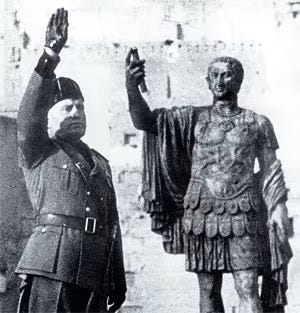
After Mussolini’s march on Rome, Zionists quickly sought an audience with him, promising loyalty to Italian fascism. While Mussolini still viewed Zionism as a tool of the British, he was willing to engage in discussions with them. Chaim Weizmann met with Mussolini in 1926 and described the encounter, stating, “Mussolini was more than cordial.” Following this meeting, Mussolini began offering to help the Zionists build their economy, and the Fascist press started publishing favorable articles about Zionism.
Ultimately, after a meeting with Nahum Sokolow, Fascism and Zionism became full endorsers of each other.
With this last meeting Mussolini became lionized by Zionism. Sokolow not only praised the Italian as a human being but announced his firm belief that Fascism was immune from anti-Semitic preconceptions. He went even further: in the past there might have been uncertainty about the true nature of Fascism, but now, “we begin to understand its true nature … true Jews have never fought against you” (Zionism in the Age of Dictators)
As one Italian Zionist would proclaim:
The new conditions will bring about a revival of Italian Jewry. Indeed, we have evolved a philosophy of Judaism akin to the spiritual Tendenz of Fascism long before this had become the rule of life in Italian polity (Zionism in the Age of Dictators)
Hitler’s rise to power was heavily influenced by the inspiration and ideological framework Mussolini provided, and the two quickly formed a relationship. However, Hitler had two major grievances with Mussolini: his suppression of Germans in some northern Italian areas and the significant number of Jews within Mussolini’s government. Initially, Mussolini chastised Hitler’s antisemitism, which gave Zionists hope that Mussolini could influence Hitler to change his views on Jews.
Up until now, we’ve primarily discussed actions taken by Labor Zionism. However, it’s important to also address another branch called Revisionist Zionism, as it has been the dominant ideology in Israel under the Likud party since 1977 and continues to shape the current political landscape.
Revisionist Zionism
The founder of Revisionist Zionism, Vladimir Jabotinsky, was a close collaborator with Benzion Netanyahu. If that name sounds familiar, it’s because Benzion Netanyahu is the grandfather of Benjamin Netanyahu, the current leader of Israel.
Despite Revisionist Zionism’s prominence today, when it first emerged under Jabotinsky (pictured here), it was actually the most fringe and disliked faction of Zionism.

Even Jabotinsky himself died in relative obscurity, excommunicated from the wider Zionist movement. However, since the 1970s, his ideology has become the dominant mainstream within Israel.
Revisionist Zionism was founded on the idea that the Zionists needed to abandon Britain and take Palestine by force, arguing that Palestinian occupation wasn’t progressing quickly enough under the Labor Zionists.
Jabotinsky also promoted his infamous concept of the “Iron Wall.” The Iron Wall was the belief that the Jewish people needed to build a strong military force capable of brutally displacing the Arab populations of Palestine, as he believed they would never accept their land being taken peacefully. This contrasted with Labor Zionists, who still believed in the possibility of peacefully buying Palestinian land and marketed themselves as moderates—though, ironically, this didn’t prevent them from committing acts such as the Nakba.
As Vladimir Jabotinsky would declare:
Zionist Colonization must be either terminated or carried out against the wishes of the native population. This colonization can therefore be continued and make progress only under the protection of a power independent of the native population-an Iron Wall which will be in a position to resist the pressure to the native population.
In addition Jabotinsky would also say:
If you wish to colonize a land in which people are already living, you must provide a garrison for the land…Zionism is a colonizing adventure and therefore it stands or falls by the question of armed force.
The Iron Wall, then, becomes the ultimate revelation of Zionism’s true nature: it posits the idea that Zionists are a foreign force in the region, and their presence can only be sustained through continual violence and destruction of the native inhabitants.
Netanyahu himself has expanded on the Iron Wall theory, stating that:
A Jewish state could only be created from a position of overwhelming military strength, by proving in arms to the Palestinians and the Arab states, that Zionism could not be defeated

Revisionist Zionism would be one of the most fascist-friendly branches of Zionism, and its proud and open collaboration with fascists could not be seen better anywhere than in its founder, Jabotinsky.
Jabotinsky began his political career in 1922, where he collaborated with and formed Jewish legions in Maxim Slavinsky’s army, a White Army general known for pogroms against Jews.
After this, he would join the WZO and form a coalition within it. By 1931, Revisionist Zionists would hold up to 25% of the WZO. With British protection for Zionism and the project in Palestine slowing down, Jabotinsky would begin looking for new allies, which would lead him to Mussolini for funding of the Iron Wall. No Zionist movement would have a better connection to fascist Italy and Mussolini than the Revisionist Zionists.
In 1934, the Revisionist Zionists would even be allowed to set up party schools in fascist Italy next to the Black Shirts. In fact, the Revisionist Zionists would be so heavily inspired by the union-busting activities of Mussolini’s Brownshirts that the Revisionist Zionists would organize paramilitaries to crush workers’ strikes in occupied Palestine.
In the mid-1930s, the Italian fascists began moving away from the WZO, seeing it really as an extension of British interests. As a result, they became very entrenched with the Revisionist Zionists, whom Italian fascists even lovingly dubbed the “Fascists of Zion.”

Vladimir Jabotinsky and his clique would break with the WZO in 1932, founding the New Zionist Organization (NZO). The first Revisionist Zionist Congress would even be planned to be held in Trieste, Italy, with the support of Mussolini himself. (Though this plan would fall through in the end.)
Labor Zionists would openly call the Revisionist Zionists fascists. Chaim Weizmann and Ben Gurion would even call Vladimir Jabotinsky, “Vladimir Hitler.”
Mussolini on the Revisionist Zionists would even proclaim:
For Zionism to succeed you need to have a Jewish state, with a Jewish flag and a Jewish language. The person who really understands that is your fascist Vladimir Jabotinsky.
-Mussolini
Wolfgang Weisl of the Revisionist Zionists would proclaim that the movement “in general sympathized with fascism.”
In Israel, the Revisionists would even set up a newspaper called Yomen Shel Fascisti (Diary of a Fascist), and the Revisionist Zionists’ followers would even wear brown shirts reminiscent of their fascist cousins.
Jabotinsky’s militia of Revisionist Zionists, the Irgun, would be most infamous for bombing the King David Hotel in Jerusalem, where the British administration was killing 91 people.

abotinsky himself would become Mussolini’s biggest public defender within the Jewish world, writing articles in defense of Mussolini, and would see Mussolini as the biggest possible ally in the settlement of Palestine. This grand alliance between Mussolini and the Revisionist Zionists would ultimately end as Mussolini aligned himself with the more openly antisemitic Hitler, leaving Jabotinsky sad, isolated, and dying alone in 1940. But the fascist Revisionist Zionist connection was resoundingly strong.
The Betar faction would even viciously attack other Zionists in occupied Palestine with brown shirts, and when they began killing political opponents, they actually happily took on the identity of Jewish Nazis, though Jabotinsky himself was not a fan of this.
The Betar faction of Revisionist Zionists would even proudly proclaim:
Yes, we revisionists have a great admiration for Hitler. Hitler has saved Germany. Otherwise it would have perished within four years. And if he had given up his antisemitism, we would go with him.
Some of the Revisionist Zionists looked fondly towards the Nazis as their brothers. The Betar Monthly, their American magazine in 1931, would even declare their support for Hitler, saying if the ideology that could save them could “be Hitlerism, then we are Hitlerites.” A group by the same name has recently been terrorizing Palestine protests in America and handing out fake papers to anti-Zionists.

When the Nazis came to power, some Revisionist Zionists would even celebrate it, seeing it as a win for their ideas. Georg Kareski, a Revisionist Zionist inspired by the Nazis, would even attempt to do his own Beer Hall Putsch (the famous failed Nazi coup) within the Jewish community in 1933. Kareski would become enthralled with Hitler and move closer to him when the Revisionist Zionists left the WZO.
Kareski and his German Revisionist clique would immediately begin attacking other German Zionists who they saw as Marxists, even in 1934 attempting to tell the Nazis that various Zionist groups were secret Marxists in the hopes that the Nazis would then give Kareski and his group all of their assets (the Nazis, who were secretly working with the WZO in the Haavara Agreement, were not keen to give up on their temporary allies, so it failed). For Jabotinsky, Kareski’s group became a headache, as Jabotinsky was trying to position himself as a ‘reasonable fascist’ of the Mussolini line.
However, soon everyone knew about his followers who were working for Hitler. Kareski’s clique, called the State Zionists, would become Hitler’s favorite Zionist movement, with the Gestapo notifying other members:
The state Zionists have proven to be the organization which had tired in any way, even illegally, to bring its members to Palestine, and which, by it’s sincere activity directed towards emigration, meets half-way the intention of the Reich government to remove the jews from Germany.
Kareski would even become a direct line of communication for the Gestapo and the Nazis’ interests in the New Zionist Organization (NZO). Kareski and his clique were immensely unpopular within the Jewish communities of Germany; however, the Nazi state would still try to force him into every single institution, putting him in charge of Jewish cultural leagues.
As Hans Hinkle, who was in charge of pushing Kareski, would say:
I have consciously allowed the Zionist movement [Kareski] to exert the strongest influence upon the cultural and spiritual activities of the kulturbund [the culture leagues] because the Zionists….have at least given us formal guarantees of cooperation in acceptable form.
Another one of Jabotinsky’s men, Von Weisl, Jabotinsky’s main negotiator with Europe, would meet with Sir Oswald Mosley’s British fascist group and propose an alliance between Britain and a possible Revisionist ‘Israeli’ State. The proposed plan would see Japan, Poland, and Germany against Arabs and the Soviets.
While Jabotinsky’s supporters openly aligned themselves with the Nazis, Jabotinsky himself privately would tell them to cease this immediately; he himself was not a fan of German fascism. And while the Revisionist Zionists supported Mussolini wholeheartedly, unlike their Labor Zionist counterparts in the WZO, the NZO would be a lot more mixed on the Nazis, with some very openly pro-Nazi factions and others, led by Jabotinsky, that were what you could call more ‘moderate fascists’ of the Italian type.
Surprisingly, Jabotinsky and his faction in the Revisionist Zionists would even independently spearhead Zionist boycotts against the Nazis. Jabotinsky, though, underestimated the threat the German fascists posed, believing a couple of years before the invasion of Poland that Hitler’s regime would collapse on its own and therefore didn’t need too much attention.
And ultimately, even the anti-Nazi Revisionist Zionists would not be interested in fighting Nazism in the European theater but instead using it as a tool to further conquer Palestine.
In one of their oddest episodes, 24 hours before Hitler’s troops marched into Poland, an armed boat of Revisionist Zionists would land on the beaches of Tel Aviv, seizing the government house in Jerusalem for 24 hours, hoping to start a Revisionist Zionist version of the Easter Uprising. It would ultimately be defeated but shows how fringe and radical Revisionist Zionism was before the 70s.
Zionists wouldn’t even try to save the Jews of Germany on the eve of the Holocaust.
The British were the ones who decided how many Jews were sent to Palestine, using considerations of Arab reaction and political maneuvering before giving the quotas to the WZO. Immigrants to Palestine likewise would be screened to make sure they weren’t communists, and rich Jewish Germans who were able to pay were always given favor.
For a short time in the 30s, the main source of Jewish emigrants would come from Poland; however, the Zionists would soon turn on the Polish immigrants, with Chaim Weizmann proclaiming that the new immigrants ruined their experiment and brought “the atmosphere of the ghetto” to occupied Palestine.
This would lead to the Zionists seeking only Jews that were committed to Zionism to give travel visas to Palestine, and in the midst of the most antisemitic sprees in Europe, they would be less focused on saving Jewish people of Europe from the coming fascist threat and more on making sure that the people who did come would contribute to the Zionist project well.
Soon only young, healthy, and committed Zionists were wanted, not the masses of Jews trying to survive the Nazis.
As Enzo Sereni would explain:
Even in this difficult hour, we must allot most of the 1,000 immigration certificates to pioneers [the young, healthy Zionists]. This may seem cruel, but even if the British were to grant 10,000 certificates instead of the 1,000 they are giving us now, we would still say: Let the young people go, for even if they suffer less than the older ones, they are better fitted to the task in Palestine.
The WZO would soon refuse to take in Jews that were not rich enough to be able to do some serious investment in occupied Palestine’s economy, which was in recession. They would also refuse to take Jews that were not young enough, with an age limit of 30 being set, as they wanted good workers and committed Zionists. As one Zionist in charge of emigration said:
We know that we are not able to transfer all of German Jewry and will have to choose on the basis of the cruel criteria of Zionism

With only limited certificates to give, a good number of them would be given to Jewish people from countries that did not even need saving (including America, Turkey, South Africa), overlooking tens of thousands of Polish and German Jews and leaving them to the clutches of Nazism. The project of Zionism to the founders of ‘Israel’ was more important than saving the Jewish people of Europe.
In the end, ⅔ of all German Jews that would apply for emigration to Palestine would be turned down. As Chaim Weizmann would say of the Jews left behind by them:
The Old ones will pass; they will bear their fate, or they will not. They were dust, economic and moral dust, in a cruel world…Two millions, and perhaps less….The rest they must leave to the future-to their youth.
During this vital time for the Jewish people of the world, Zionism betrayed them for its own selfish gains! In 1936, of the 61,302 Jews that immigrated to Palestine, only 17,421 would be from Germany, with the rest from countries that did not need emergency saving. In fact, when the British would propose to save thousands of Jewish children, Ben-Gurion (pictured here), a future Prime Minister of Israel, would respond:
If I knew that it would be possible to save all the children in Germany by bringing them over to England, and only half of them by transporting them to Israel, then I would opt for the second alternative. For we must weigh not only the life of these children, but also the history of the people of [Occupied] Palestine

Ultimately, not only would the Zionists fail to save hundreds of thousands of Jews throughout the 1930s by not allowing them to come to occupied Palestine, they would actively bar them from fleeing to other places, preferring that Jews had no places to flee if it meant fewer people going to Palestine. In the Jews’ most fateful hours, the Zionists would fail them in the pursuit of their own selfish project.
As of the writing of this article, the Zionist-Fascist alliance continues to this day. On February 9th, 2025, it was reported that the Likud party had joined Patriots.eu, an alliance of far-right, alt-right, and fascist parties all across Europe, as their only non-European member. This alliance includes the FPÖ, a party which is known derogatorily as a ‘cellar of Nazis’ within Jewish communities. Zionism and Fascism continue to be a match made in hell!

Sources
https://www.marxists.org/history/etol/document/mideast/agedict/index.htm
https://www.counterfire.org/article/the-man-in-whose-shadow-netanyahu-walks/
https://electronicintifada.net/blogs/ali-abunimah/israel-renews-racist-marriage-law
https://www.palestine-studies.org/en/node/38833
https://www.marxists.org/subject/jewish/img-zionism.pdf
https://www.aljazeera.com/opinions/2012/12/24/zionism-anti-semitism-and-colonialism
https://www.marxists.org/archive/lenin/works/1903/oct/22a.htm
Leave a Reply